






















































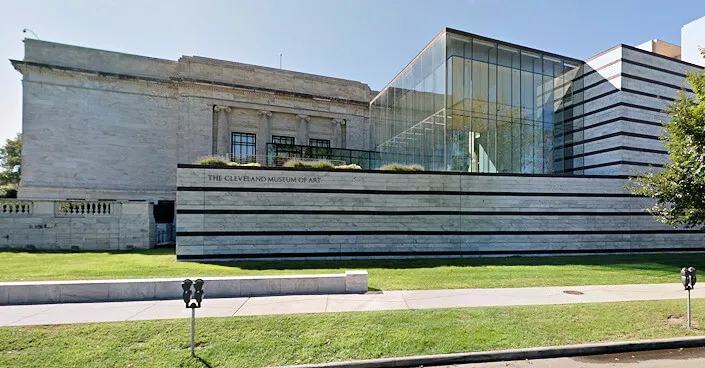
The Cleveland Museum of Art

Event Location
Cleveland, OH 44106

The Cleveland Museum of Art's collection of Japanese art is one of the most distinguished collections outside of Japan.
In 1916, when the Cleveland Museum of Art’s first building opened, its holdings in Japanese art already included some noteworthy Japanese woodblock prints designed by print world luminaries such as Okumura Masanobu (1686-1764) and Kitagawa Utamaro (1754-1806). Today, the museum’s Japanese collection comprises some 1,950 works spanning a period of approximately 5,000 years and includes masterworks of painting, sculpture, and prints, as well as ceramics, metalwork, and other decorative arts. The Japanese calligraphy and painting collection is impressive in its breadth, from sacred texts executed in silver and gold characters on dyed paper to expansive ink-painted vistas once intended for sliding door panels. Its selection of folding screen paintings covers many of the major genres, from bird-and-flower compositions to festival scenes, and includes examples by artists such as Sesson Shukei (c. 1504-1589) and Maruyama Okyo (1733-1795). The collection also contains notable works of early Buddhist and Shinto art.
Mission, Vision, Promise
The Cleveland Museum of Art was founded in 1913 “for the benefit of all the people forever.”1 We strive to help the broadest possible audience understand and engage with the world’s great art while honoring the highest aesthetic, intellectual, and professional standards.
We are proud to be one of the world’s most distinguished comprehensive art museums and one of northeastern Ohio’s principal civic and cultural institutions.
William M. Griswold was named the ninth director of the museum in May 2014.
Founding
The museum opened on June 6, 1916, after many years of planning. Its creation was made possible by Cleveland industrialists Hinman B. Hurlbut, John Huntington, and Horace Kelley, all of whom bequeathed money specifically for an art museum, as well as by Jeptha H. Wade II, whose Wade Park property was donated for the site. The endowments established by these founders continue to support the museum. The original neoclassic building of white Georgian marble was designed by the Cleveland firm of Hubbell & Benes and was constructed at a cost of $1.25 million. Located north of the Wade Lagoon, it forms the focus of the city’s Fine Arts Garden.
Establishing Programs for Children and Adults
Frederic Allen Whiting was the museum’s first director from 1913 to 1930. An authority on handicrafts, he believed in the museum as an educational institution. Under his leadership, the museum established the education department and a wide variety of programs for children and adults. In 1919 the first “Annual Exhibition of Cleveland Artists & Craftsmen” was held. This exhibition soon became known as the May Show, and continued to showcase local artists for 73 years.
Contact
Phone: (216) 421-7350Location Website
Click to Visit
(For Event Information See Event Website Page)

Authentic Japanese Gardens (United States)
Best Japanese Gardens
Japanese Rock 'Zen' Gardens (United States)
Best Japanese Rock 'Zen' Gardens
Japanese Teahouses (United States)
Best Japanese Teahouses
Japanese Museum Art
Japanese Museums Map of Japanese Museums