
























































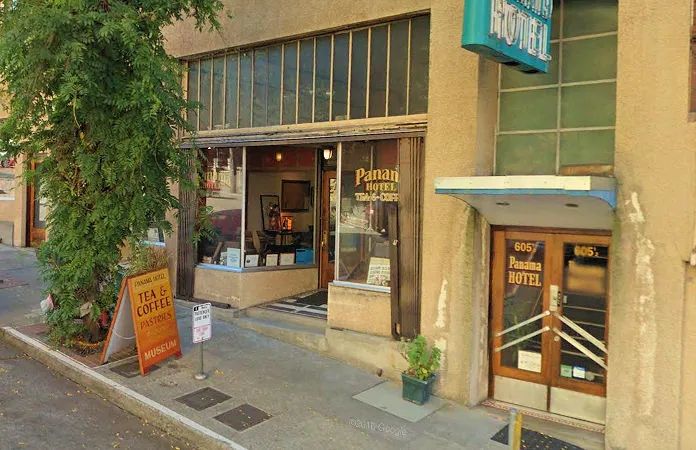
Panama Hotel Tea & Coffee House (Historic built in 1910)

Event Location
Seattle, WA 98104

The Historic Panama Hotel built in 1910 by Sabro Ozasa, a Japanese Architect and graduate of the University of Washington. Through the years it has served as a home for generations of Japanese immigrants, Alaskan fisherman and International travelers. The building houses the only remaining Japanese Bathhouse (Sento) left in tact in the United States. These Facilities served generations of Seattle's Japanese community until closing its doors in 1950, and has remained preserved as it was to this day.
The Panama Hotel was built as a 'workingman's' hotel, and is centrally located in Seattle's Historic International District, very close to downtown and the stadiums. What the hotel lacks in amenities it makes up in charm. The brick outer facade opens up into a steep stairway flanked by bright brass handrails and illuminated by recessed lighting reflecting off of smooth tile. It reminds us of classic Hollywood. The rooms are small with personal sinks and white linens. There are separated men and women's bathrooms for each floor that are shared among approximately five rooms. Residents of the hotel are serviced with daily maid service and a central lounge. There is parking nearby although not covered in the hotels rate. Currently the hotel serves as a Historic place to stay while visiting Seattle and porthole view into Seattle's past and present.
National Landmark
It was declared a National Historic Landmark building in 2006, and on April 9, 2015, the Panama Hotel was designated a National Treasure by the National Trust For Historic Preservation - one of only 60 in the United States. -wikipedia
Editor
The Panama Hotel in Seattle, Washington's International District was built in 1910. The hotel was built by the first Japanese-American architect in Seattle, Sabro Ozasa, and contains the last remaining Japanese bathhouse in the United States.
The Panama Hotel and Tea House, anchors what was once the heart of Seattle's Nihonmachi, Japantown, one of the most thriving communities of its kind in the country. It was built in 1910 by the city's first Japanese architect, and for the next three decades, the lower floors of the five-story workingman's hotel were home to a laundry, dentist, tailor, pool hall, book store, florist, sushi shop and sento, a Japanese-style public bathhouse.
Of hundreds of such communal bathhouses in Japantowns across the country, this is the only one preserved intact, in place.
Maintaining the high standards set by previous owners Takashi and Lily Hori, Johnson is fastidious about the cleanliness of the white linens and comforters in the hotel rooms. She is active in every aspect of running the hotel, from fixing plaster to making beds.
Contact
Phone: (206) 515-4000Location Website
Click to Visit
(For Event Information See Event Website Page)

Saturday, 24 January, 2026
Authentic Japanese Gardens (United States)
Best Japanese Gardens
Japanese Rock 'Zen' Gardens (United States)
Best Japanese Rock 'Zen' Gardens
Japanese Teahouses (United States)
Best Japanese Teahouses
Japanese Museum Art
Japanese Museums Map of Japanese Museums